Half-Time Hokey-Cokey: Twenty Minutes Inside a Regional Theatre Interval
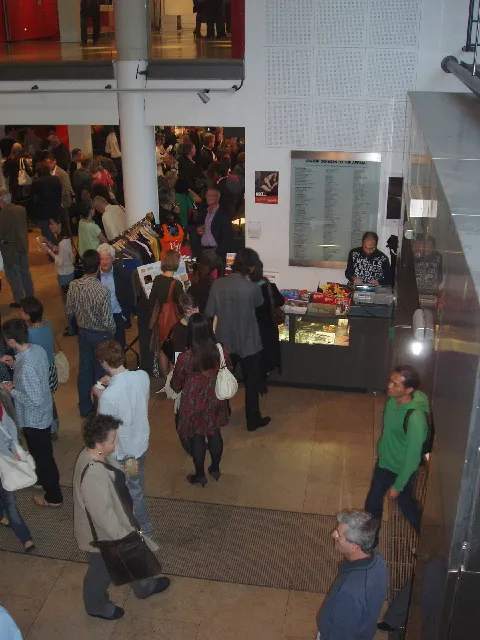
Photo: David Hawgood, CC BY-SA 2.0, via Wikimedia Commons
The curtain lands at 7:32pm. By 7:33pm, the foyer of this 420-seat regional theatre in the north of England has stopped being a foyer and become a small, carpeted weather system. It is a wet Tuesday in October, the kind of night where everyone arrives with a coat that needs somewhere to go, and the interval is when the building audibly exhales.
I am standing by the sweet counter with Denise, the duty manager, who has been doing this job for eleven years and has the calm of someone who has seen every possible variation of a spilled drink. "People think the interval is just a queue," she says. "It's actually a small operations exercise. We just try not to make it look like one."
7:32pm — The doors open before the applause dies
The house lights come up on a half-standing auditorium. Ushers positioned at the two rear doors have already propped them open with wooden wedges, a job that happens in the last thirty seconds of the act. Chloe, an usher who has worked here for three years, is on the left-hand door. She has a lanyard, a torch the size of a thumb and the expression of a person who knows exactly how many people will try to leave via the wrong exit.
"You get about ninety seconds where everyone is polite," she says later. "Then the aisle gets congested and someone decides they're going to nip round the side, and you have to sort of gently herd them back without making them feel silly." The herding is constant. It is also invisible.
7:36pm — The queue that isn't a queue
The bar has four staff on, which is two more than during the first act. Marek, the bar manager, has worked in theatres for fifteen years and treats the interval as a sporting event with a fixed final whistle. He has pre-poured twenty glasses of white wine, stacked the ice cream tubs in a pyramid and put the card machine on its longest cable.
"It's not the pouring that gets you," he says. "It's the changeover. Someone wants a coffee, someone wants a glass of tap water, someone wants to know if the ice cream has nuts in it. You're answering three questions while you're pouring a pint. You get good at reading the person at the front of the queue."
The queue is long but it moves. That is the trick. A queue that moves feels like a service; a queue that doesn't feels like a decision someone made about you.
7:41pm — Accessibility isn't a side quest
By the accessible toilet, there is a small knot of people and one usher, Ruth, who is doing what looks like nothing but is actually a carefully managed one-in, one-out system. The theatre has two accessible toilets and one lift. At 7:41pm on a busy night, those are the most in-demand square metres in the building.
"We get a lot of requests that aren't really about toilets," Ruth says. "Someone needs a chair. Someone needs to know where the step-free route is. Someone's mum is a bit wobbly on her feet and doesn't want to make a fuss. You learn to spot the person hovering."
Denise calls this "the quiet bit of the job" — the part that doesn't show up in the interval announcement but determines whether someone comes back. "You can have a great show and a bad interval," she says. "People remember the bad interval."
7:47pm — The great ice-cream arithmetic
The sweet counter is doing a brisk trade in tubs. A small child in a sparkly dress has been sent up with a ten-pound note and a very specific brief: one strawberry, one chocolate, no sprinkles for her brother because he doesn't like them, and two bottles of water. The transaction takes ninety seconds. It is, by any measure, a logistical triumph.
Behind the counter, the arithmetic is constant. How many tubs left? How many spoons? Has anyone dropped a scoop on the floor? (Yes. Someone always does.) The interval is a series of small counts.
7:52pm — Spills, squash and the mop protocol
There is a spill by the stairs. It is not a dramatic spill — a bit of white wine, a bit of orange squash, a napkin doing its best — but it requires a mop, a yellow sign and a member of staff who can move through a crowded foyer without causing a second incident. This is the bit of the interval that nobody photographs.
Chloe has a theory about spills. "They happen in the same three places," she says. "The top of the stairs, the corner by the bar, and the bit where the carpet changes. I don't know why. It's like the building has opinions."
7:56pm — The duty manager's walk
Denise does a circuit of the building. Bar: queue moving. Toilets: manageable. Foyer: one spill, already coned. Front doors: two people outside having a cigarette and a conversation about the first act. Box office: quiet, which is good, because box office quiet means nobody has a problem that needs solving.
She stops by the front-of-house desk and checks the radio. A small crackle. "We use radios and we use hand signals," she says. "Sometimes a look across the foyer is worth a whole conversation."
8:01pm — The bell, the bin bag, the last loo roll
The first bell goes at 8:01pm. It is a recorded chime, but it might as well be a starter pistol. The bar staff start their final push. The ushers move towards the doors. Someone in the toilets shouts, "Is that the bell?" and someone else says, "That's the first one, you've got five minutes," and the whole building does a small, collective calculation.
Behind the bar, Marek is already restocking for the second interval — the one after the show, when the bar will do a different kind of trade, slower and more conversational. "You're always thinking two intervals ahead," he says.
8:04pm — Act two starts without you noticing
By 8:04pm, the foyer is nearly empty. The queue has gone. The spill has been mopped. The ice-cream tubs have been counted, the bins emptied, the doors wedged open for the latecomers who will be held in the foyer until the first suitable moment. The building has reset itself.
Denise takes a breath. "And then you do it all again in two hours," she says. "People ask what we do during the show. We do this. We do the next interval. We do the one after that."
The interval is twenty minutes long. It contains about a hundred small decisions, most of which will never be noticed. That is, perhaps, the point.