The Quiet Fifteen: Inside a Touring Company's Pre-Show Warm-Up
Photo: Internet Archive Book Images, Public domain, via Wikimedia Commons
At 6.45 on a damp November evening in 2026, the auditorium is still empty. The front-of-house staff are checking the bars, the stage door has that familiar smell of coffee and radiator dust, and somewhere in the wings a company is beginning the fifteen minutes that nobody claps.
The half will be called at 7pm. Curtain up is 7.30. In between sits a small, private piece of theatre that happens in stairwells, dressing rooms and the gap between the tabs. It is not the show. It is the thing that makes the show possible.
The call that isn't a cue
A touring company learns to read the building quickly. Some venues have a warm-up room with a mirror and a decent radiator. Others have a corridor, a stack of flight cases and a noticeboard still advertising a panto from three winters ago. Either way, the ritual is roughly the same.
First comes the voice. Not the full belt, not yet. Just lip trills, a few sirens, maybe a tongue twister that sounds like nonsense until you realise half the company is using it to check their diction. Someone hums a phrase from the score. Someone else laughs at a joke that is not really a joke, just a way of releasing the jaw.
The physical warm-up is less mysterious. Spine rolls. Shoulder releases. Calf raises. A few actors swear by a particular stretch; others stand in the corner doing something that looks like a shrug with intent. It is not elegant. It is not meant to be.
What matters is that it is regular. On a long tour, the warm-up is one of the few things that stays the same when the theatre changes, the schedule shifts and the digs are different every week.
Voices in the stairwell
If you walk through a regional theatre at quarter to seven, you will hear the company before you see them. A soprano running scales under her breath. A bass-baritone doing a gentle hum that vibrates through the door frame. Two actors sharing a laugh that turns into a breathing exercise halfway through.
The stairwell is often the best place for it. Concrete steps, hard walls, nobody lingering. On a wet Tuesday in Leeds or Southampton, it can feel like the most honest room in the building. No audience, no lighting state, no pressure to be charming. Just breath, sound and the small business of getting ready.
For newcomers, this can be a surprise. Drama school makes warm-ups look like a group activity with a teacher at the front. A touring company makes them look like a private habit. Everyone is doing their own version, in their own space, and somehow it still adds up to a shared beginning.
Fight call, fight face
If the show has a fight, the fifteen minutes before the half will include a fight call. This is not a rehearsal. It is a safety check. The actors walk the sequence slowly, then at performance speed. They check the distance, the timing, the angle of a fall, the place where a hand lands on a shoulder.
A good fight call is calm. It is full of small, practical questions. Is the floor more slippery than last week? Has the set moved two inches stage left? Is that the same dagger, or a replacement? The answers matter more than the drama.
There is also the face. Not the character's face, but the actor's face doing the mental arithmetic of the sequence. You can see it in the mirror sometimes: a furrowed brow, a muttered count, a quick nod when the timing lands. Then it is done, and the company moves on.
The zip test and the quick-change check
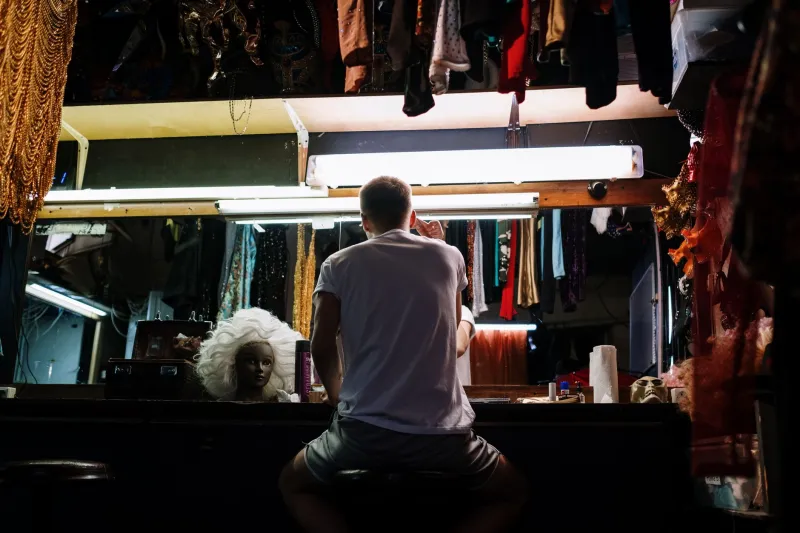
In the dressing rooms, the work is quieter but just as precise. A quick-change is only quick if someone has checked it. Zips run up and down. Poppers are pressed. Magnets are tested. A dresser might ask for a twirl, a reach, a crouch. The actor obliges, sometimes mid-sentence, sometimes with a sigh.
On tour, the quick-change is also a packing problem. Costumes have been in a truck, in a wardrobe case, in a dressing room with a radiator that is either too hot or not working. Velcro loses its grip. A hook and eye goes missing. The fifteen minutes before the half is when those small failures are found and fixed.
It is not glamorous work. It is the reason the glamorous work looks effortless.
Small superstitions, steady hands
Every company has its rituals. Someone taps the door frame on the way out. Someone refuses to whistle backstage. Someone wears the same socks for a first preview and pretends it is not a superstition. Someone else always says 'break a leg' and then apologises for saying it too early.
These habits are not silly. They are anchors. A touring company is a temporary village, and the warm-up is the moment the village checks its doors and windows before the visitors arrive.
There is also the practical superstition: the check that has become a habit because it once went wrong. The prop that was left on the wrong table. The hat that went missing. The button that popped. The actor who now always checks the same pocket before every show, not because they are nervous, but because they remember.
The last five minutes
The half is called. The company drifts towards the wings. The stage manager's voice is calm and ordinary. The front-of-house doors are open. The audience is beginning to fill the seats, shaking off coats and reading programmes.
In the wings, the warm-up is over. What remains is the hush. A few last words. A hand on a shoulder. A breath in, a breath out. The lighting state changes. The music cue begins.
Nobody claps for the fifteen minutes before the half. They are not meant to. They are the unglamorous, repetitive, deeply practical start of the evening. But if you have ever stood in a stairwell at quarter to seven, listening to a company warm up, you know the truth: the magic does not begin when the curtain rises. It begins a little earlier, with a lip trill and a zip check and someone asking, 'Is this the right dagger?'